Write the brief
State the audience, subject, desired slide count, tone, and outcome in one compact request. Include the essential points that cannot be omitted.
Presentation workflow
A runable ai presentation workflow starts with a focused brief, a defined audience, and a clear visual direction. Use this guide to test the process without treating an early draft as a finished deck.

Related guides
These nearby guides cover adjacent ways to use Runable, from visual assets to complete web concepts.
Before you begin
The quality of a presentation draft depends heavily on the information and decisions supplied before generation begins.
If the brief does not say who will view the deck, the tone and level of detail may feel generic.
WorkaroundName the audience, their context, and the decision you want them to make.
A topic alone does not establish a useful narrative, so the sequence may lack a clear point of view.
WorkaroundGive each slide one job, such as framing a problem, proving traction, or asking for action.
The workflow should not be treated as a substitute for verified facts, approved figures, or final brand guidance.
WorkaroundPrepare the facts, references, logos, and wording that must remain accurate before reviewing the draft.
An initial output is better understood as a starting concept than as a presentation ready for an important audience.
WorkaroundReserve time for editing, fact checking, accessibility review, and final visual decisions.
The basic path
A practical run-through keeps the request specific enough to guide the structure while leaving room to refine the visual direction.
State the audience, subject, desired slide count, tone, and outcome in one compact request. Include the essential points that cannot be omitted.
Check whether the proposed sequence tells a coherent story before focusing on colors, imagery, or polish. Remove slides that do not move the argument forward.
Correct claims, replace placeholders, align the visual language with the brand, and adapt the wording for the people who will actually see the deck.
Practical scenarios
Different people can use the same workflow as a starting point, provided they keep ownership of the facts and final decisions.
Turn a product idea into a short investor narrative with a problem, solution, market, and next step.
A clearer structure for deciding what evidence belongs in the pitch and what still needs work.
runable websiteSketch a campaign story before the team commits to a full set of channels and creative assets.
A reviewable direction that helps stakeholders react to the message early.
runable ai imageOrganize a client workshop around a challenge, findings, recommendations, and an agreed action plan.
A usable discussion scaffold that can be edited around the client’s evidence.
what is Runable AI used forShape a lesson outline with a learning goal, explanation, examples, and a recap.
A first-pass teaching sequence that can be checked against the learners’ needs.
runable ai imageSummarize a project update with progress, risks, decisions needed, and ownership.
A concise review format that makes gaps visible before the meeting.
runable websiteVisual checkpoint
The comparison is a planning aid: a rough starting point should become more intentional after the narrative and audience are clarified.
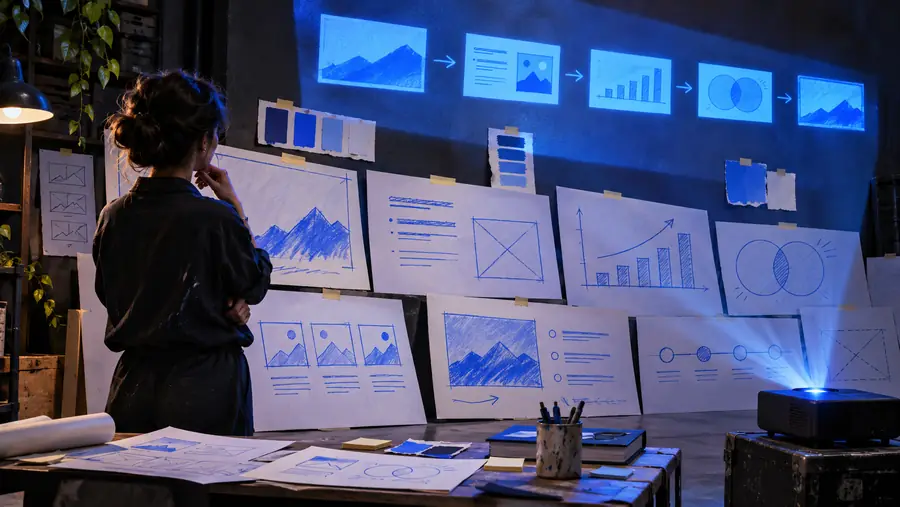

The second stage still needs human review for facts, hierarchy, and brand fit.
Decision guide
Use this side-by-side view to decide what belongs in the first draft and what should remain a deliberate human decision.
Runable first draft
Explore a presentation structure and visual direction.
Human final pass
Approve the story, evidence, and final message.
Runable first draft
A concise brief with audience, topic, tone, and required points.
Human final pass
Source documents, approved facts, and brand guidance.
Runable first draft
Suggest an order for the main ideas and supporting sections.
Human final pass
Judge whether the sequence persuades, teaches, or informs effectively.
Runable first draft
Generate an early concept for layout, mood, and emphasis.
Human final pass
Resolve hierarchy, consistency, accessibility, and brand fit.
Runable first draft
Cannot replace verification of claims, figures, or citations.
Human final pass
Check every important statement against trusted source material.
Runable first draft
Useful as a draft or discussion artifact.
Human final pass
Responsible for the version shown to clients, leaders, or a public audience.
Keep control
A presentation request can produce a weak result when the audience, purpose, evidence, or visual constraints are left unstated. Runable can help you explore a direction, but it should not be presented as a fact checker, an approval process, or a replacement for editorial judgment. Start with one defined outcome, then review every important slide before sharing it.
Common questions
It can be approached as a way to explore a presentation structure and visual direction from a focused brief. The resulting draft should be reviewed and edited before it is used with an important audience.
Include the audience, subject, desired outcome, tone, essential points, and any constraints such as brand language or required sections. More specific inputs make the first direction easier to evaluate.
No single draft should replace human decisions about narrative, accuracy, accessibility, or brand fit. It is more useful as an early concept that helps a person decide what to keep, change, or develop.
A draft may feel generic when the audience or purpose is unclear, and it may contain wording or claims that require verification. Check the structure, facts, hierarchy, and final presentation context before sharing it.